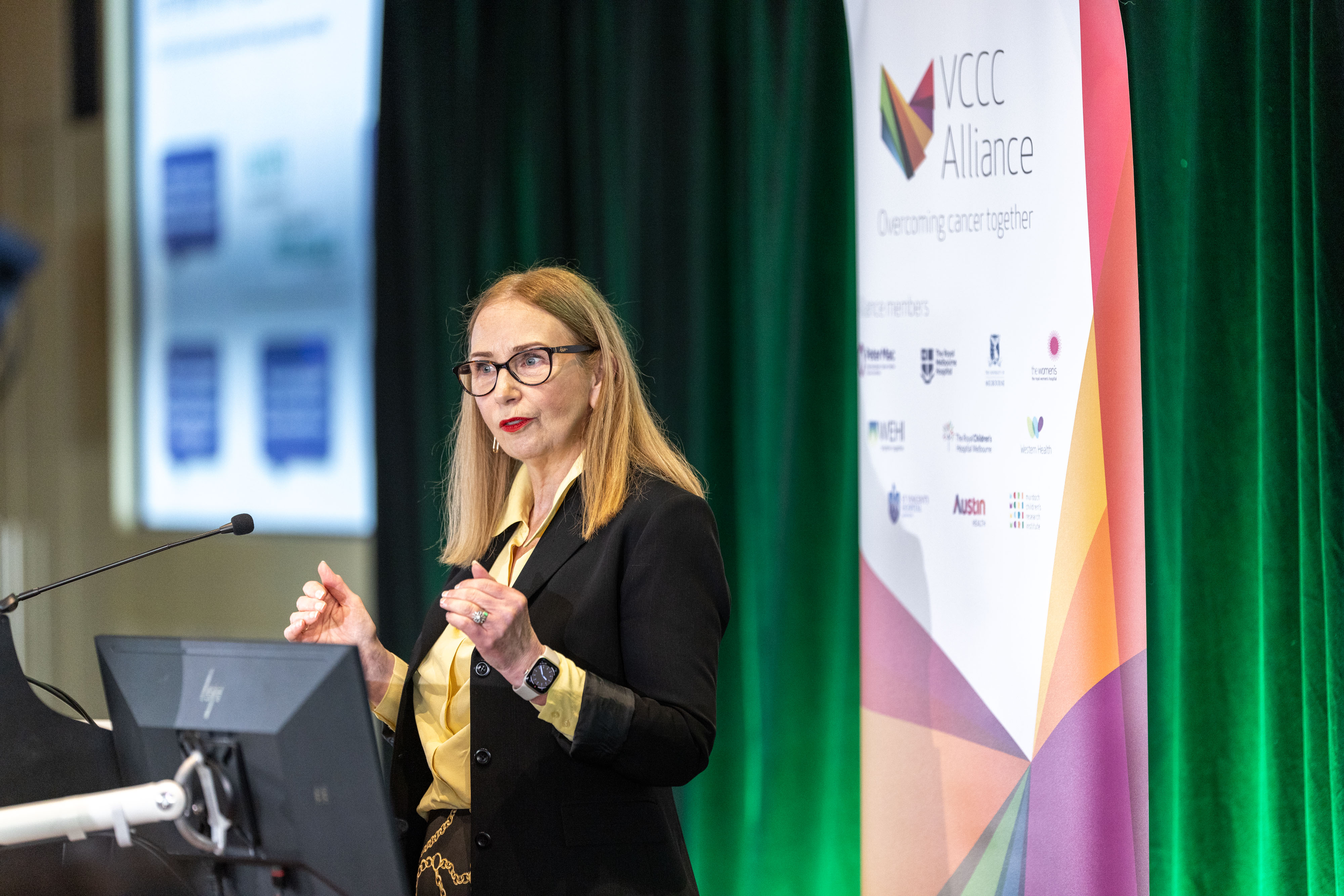





Professor David Ashley is a Melbourne born and bred success story. His appointment as the new Victorian Comprehensive Cancer Centre (VCCC) Alliance CEO has reignited his passion to enhance cancer outcomes for Victorians. A paediatric and adult neuro-oncologist, Professor David Ashley will return home after nine years in the United States leading the Preston Robert Tisch Brain Tumour Centre in North Carolina.
“I think the biggest thing that I've learned from previous leadership roles is to listen, to engage and to understand the culture of an organisation. And, you know, to take the pulse, if you will, over a period of time before embarking on any kind of wild strategic changes.”
“I've worked in both metro and regional environments across different age spectrums in direct cancer care. I've done research at the very highest level and have been fortunate in my career to work with four Nobel laureates.
“I’ve seen firsthand what makes good science and what makes good clinical care. Additionally, I've worked in multiple different jurisdictions and can see how the revenue and expenditure balance works.”
“I think I can bring all those things, but probably the most important thing is to be a good listener, understand culture and be a good source that people can trust.”
He’ll be keeping his skills honed via a clinical role at the Peter MacCallum Cancer Centre, and as a research lab head at the Walter & Eliza Hall Institute (WEHI) in The Brain Cancer Centre.
“I think it's hard to walk into a clinical space or group and have cache if you haven't practiced for a decade. It was important to me to be able to continue to stay active in those areas,” Professor Ashley said.
“I’m excited by these appointments, and I think there's an opportunity to build better and bigger collaborations both in and outside of the precinct; to lift it up in order of magnitude and impact.”
This is where he is leading by example, as Professor Ashley is bringing a $2 million research grant back to Australia with him.
“I chair a national brain tumour consortium in the United States that's funded by the Department of Defence. When I announced that I was leaving, the members said, ‘Well, why don't you continue in that international chair role, and we’ll bring Melbourne on as a site?’ So, Melbourne will be the sixth site. Dr. Jim Whittle, an eminently qualified neuro-oncologist who is also based at WEHI and Peter Mac will be the Principal Investigator here in Australia.”
A focus on innovation is a key pillar of the VCCC Alliance and an area that Professor Ashley is keen to explore.
“The VCCC Alliance Data Connect+ program is a great example of an innovative and impactful data-based initiative that can produce on-the-ground, implementable change in the clinical space, once it’s given the support to get going,” Professor Ashley said.
“I think the data space, which includes new technologies, artificial intelligence, machine learning, and big data, is really important. For example, by leveraging or using artificial intelligence, there are so many efficiencies and scalable practical solutions that can come from that technology, which could save millions of lives and millions of dollars. I think Victoria is primed to be able to deliver more in these new technology areas, but it will take some investment.”
Clinical trials are another area ripe for VCCC Alliance expansion, which the Alliance has already developed innovative expertise and programs.
“Drug registration processes for cancer patients are incredibly complex in the US, relative to Australia,” Professor Ashley said. “Clinical trials are much easier to prosecute in Australia. Of course, the US has access to the larger populations, but I think the niche that Australia can fulfil is to be able to deliver on the technical aspects, and on the innovation that can then be implemented in overseas markets.”
“We are already doing great things in that area, but I would like to explore how we could be doing more.”
A father of six, Professor Ashley is looking forward to settling back in Melbourne, although some of his older children will remain at universities in the US, and one is heading to Canada a month after he returns home.
The other strong pull was Melbourne itself, a city he loves with a passion that’s almost as strong as his desire to improve cancer outcomes.
“It will be good to be home.”