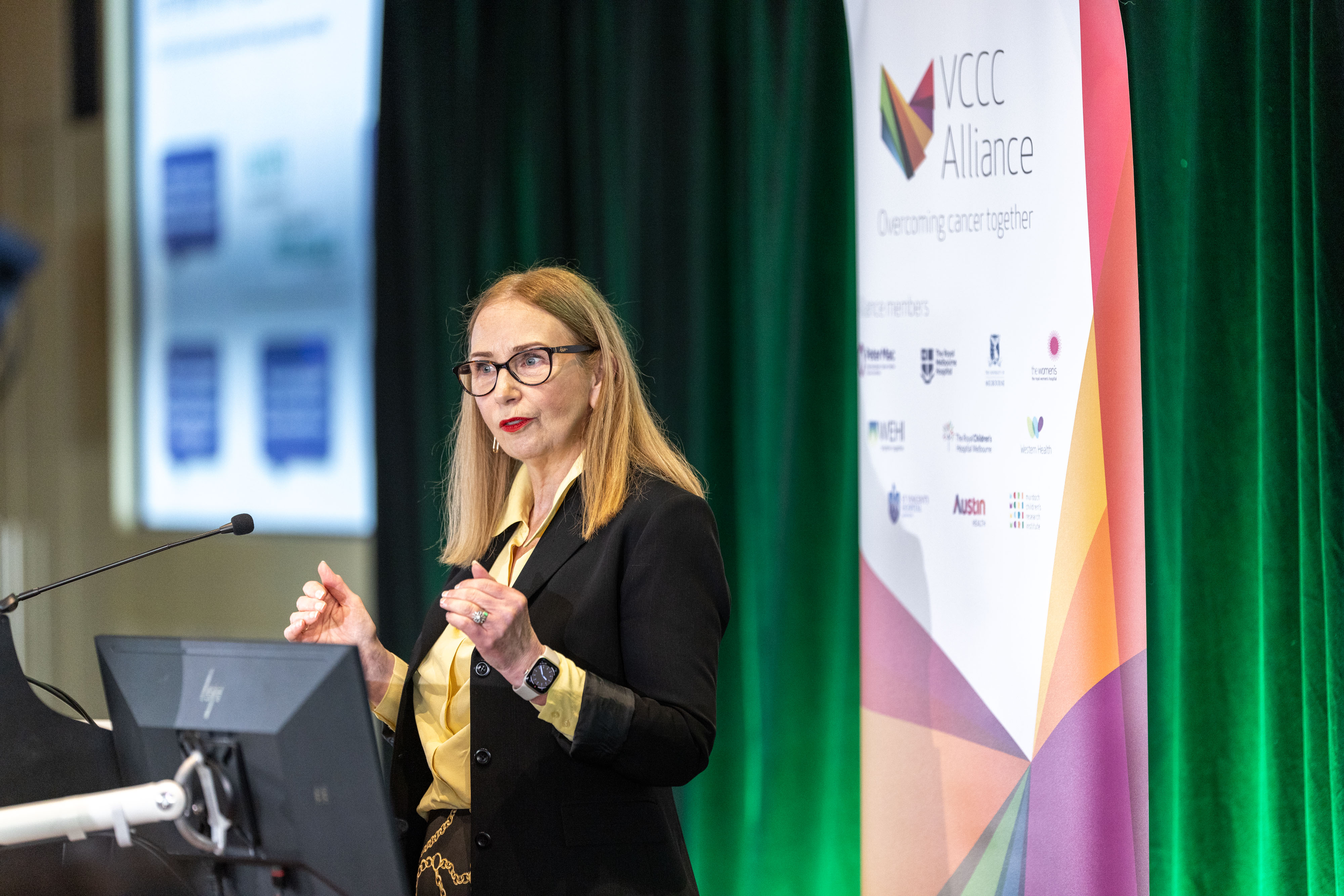






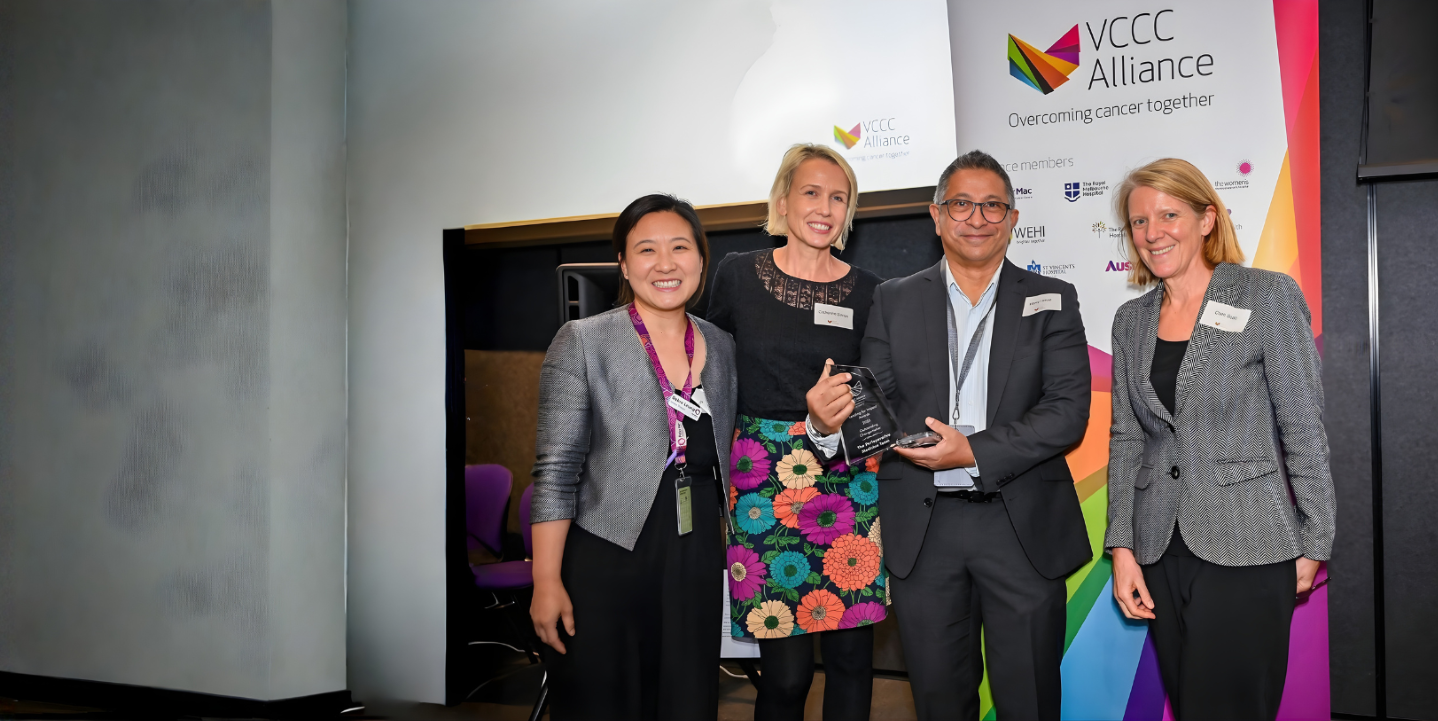
The Perioperative Medicine Team led by Professor Bernhard Riedel at Peter MacCallum Cancer Centre has been awarded the Outstanding Changemaker award in the 2025 VCCC Alliance Leading for Impact Awards.
The multidisciplinary team was recognised for developing a comprehensive model of care to improve access, safety and outcomes for cancer patients across the VCCC Alliance member hospitals and beyond.
The team built a system with six integrated steps including triaging patients for optimisation with prehabilitation before surgery, safe recovery, and readiness for cancer therapy after initial treatment. These steps expand on the high-quality anaesthesia and pain medicine delivered by the service.
A Peter Mac initiative, the model has elements that have been implemented at other networks, a co-designed prehabilitation toolkit available nationally and internationally, and published research and clinical guidelines to widely share the innovations that have been developed.
“The team has led a unique approach to patient care, service delivery and research that is equitable, consumer-centred, and scalable regionally and nationally,” said Executive Director of Cancer Research at Peter Mac, Prof Ricky Johnstone.
Ongoing research studies funded by NHMRC/MRFF grants that ensure continuous innovation and spread include: PRECAST Al for surgical risk prediction and decision-support; STARRS virtual surgery school for patient education; PRIORITY-CONNECT-2 – a virtual prehabilitation hub – for delivering multicentre prehabilitation; PPGX for pharmacogenomic guided perioperative care; PROSPER for postoperative pain management after major surgery.
PRIORITY-CONNECT 2 expands virtual prehabilitation across Victoria and NSW in partnership with the Royal Prince Alfred Hospital, Sydney. It is funded by MRFF and received the 2025 Sydney Excellence Award for Health Research and Innovation.
The PRECAST Al infrastructure program, the multicentre PREHAB trial, and registry-embedded trials position the team to deliver generalisable, high-value perioperative care is conducted with industry partners and collaborates with internationally (Copenhagen, Denmark).
Other international collaborations include the FASTWALK study (Toronto, Canada), the PREHAB multicentre RCT (Cologne, Germany), and the ENCORE-RIOT study (Karolinska Hospital, Sweden).
The team also contributes to numerous clinical best-practice guidelines, including the international ERAS guidelines for colorectal surgery and the Perioperative Quality Improvement Initiative (POQI, UK and US) consensus guidelines across numerous domains, including perioperative nutrition, shared-decision making (SDM), value-based health care, and enhanced care units.
Equity and consumer voice are designed into the perioperative medicine pathway. Universal prehabilitation is delivered through the Virtual Surgery School, translating the essentials of preparing for surgery into five languages. More than 470 unique users were engaged in initial months, across 760 sessions, with almost 70 per cent outside metropolitan Melbourne, directly addressing geographic and language barriers to preparation.
Phone and video clinics are routine, and tele-prehabilitation is scaled through PRIORITY and the PRIORITY-CONNECT2 research studies, ensuring rural and regional patients can access the same research and evidence-based preparation as those in Parkville. Allied health prehabilitation interventions are also provided through telehealth consultations, which improves access to prehabilitation for regional and rural patients.
Patient reported outcome measures (PROMs) and patients reported experience (PREMS) inform shared planning for prehabilitation, surgery, and recovery, and the patient voice is ensured through Shared Decision-Making.